

Within the Shadow Health platform, complete the Focused Exam: Cough Results
Within the Shadow Health platform, complete the Focused Exam: Cough Results. The estimated average time to complete this assignment each time is 1 hour and 15 minutes. Please note, this is an average time. Some students may need longer.
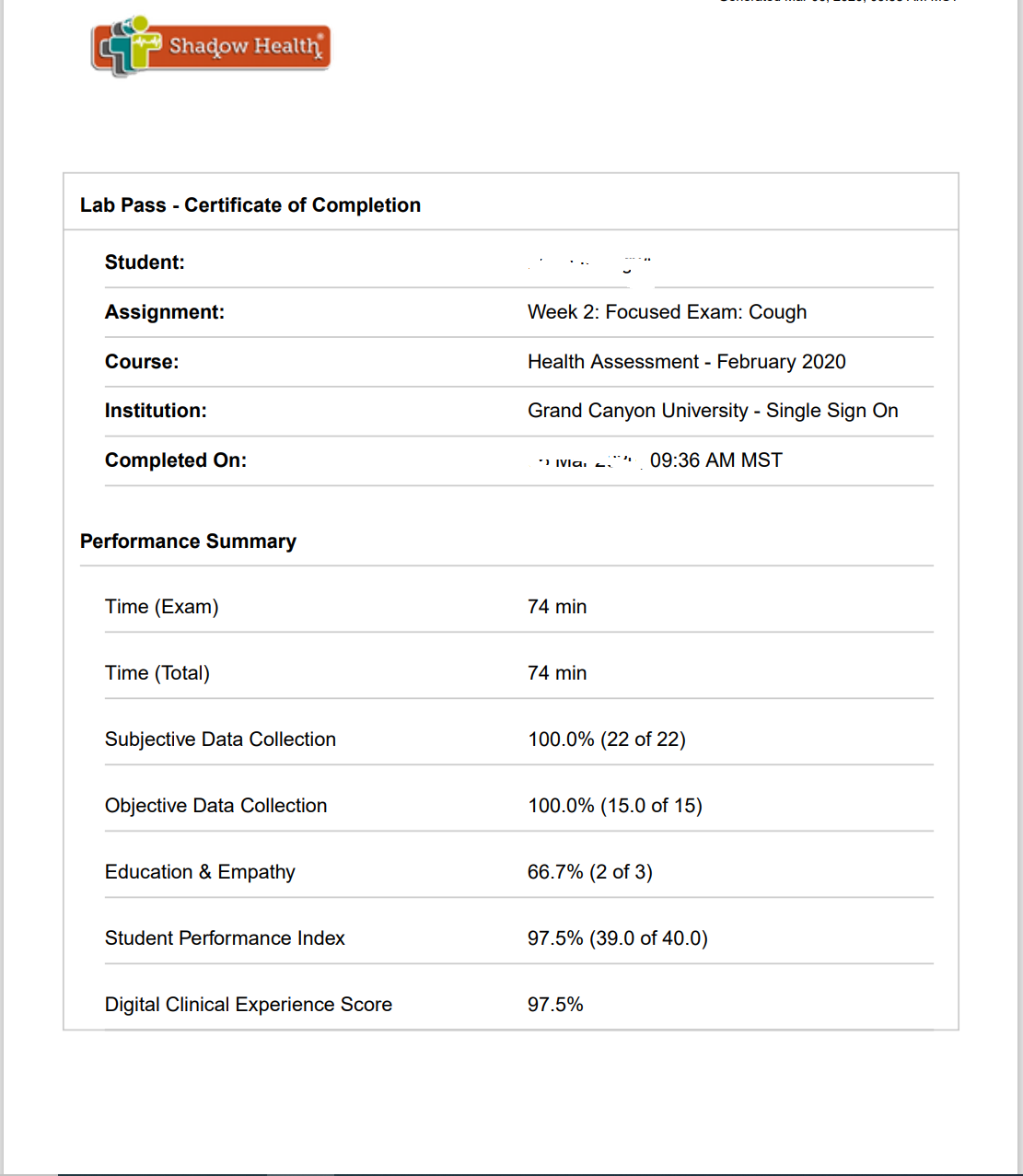
This clinical experience is a focused exam. Students must score at the level of “Proficient” in the Shadow Health Digital Clinical Experience. Students have three opportunities to complete this assignment and score at the Proficient level. Upon completion, submit the lab pass through the assignment dropbox.
Students successfully scoring within the Proficient level in the Digital Clinical Experience on the first attempt will earn a grade of 100 points; students successfully scoring at the Proficient level on the second attempt will earn a grade of 90 points; and students successfully scoring at the Proficient level on the third attempt will earn a grade of 80 points. Students who do not pass the performance-based assessment by scoring within the Proficient level in three attempts will receive a failing grade (68 points).
If the Proficient level is not achieved on the first attempt, it is recommended that you review your answers with the correct answers on the Experience Overview page. Review the report by clicking on each tab to the left titled Transcript, Subjective Data Collection, Objective Data Collection, Documentation, and SBAR to compare your work. Reviewing this overview and the course resources may help you improve your score.
Please review the assignment in the Health Assessment Student Handbook in Shadow Health prior to beginning the assignment to become familiar with the expectations for successful completion.
You are not required to submit this assignment to LopesWrite.
Expert Answer
Topic 2 DQ 1
Child abuse and maltreatment is not limited to a particular age—it can occur in the infant, toddler, preschool, and school-age years. Choose one of the four age groups and outline the types of abuse most commonly seen among children of that age. Describe warning signs and physical and emotional assessment findings the nurse may see that could indicate child abuse. Discuss cultural variations of health practices that can be misidentified as child abuse. Describe the reporting mechanism in your state and nurse responsibilities related to the reporting of suspected child abuse. Identify two factors that increase the vulnerability of a child for abuse in the age group you have selected.
Expert Answer and Explanation
The Health Assessment of Infants
All children including infants, toddlers, pre-school, and school-age children can experience child abuse in many forms. School-age children are among the most exposed to many forms of abuse, as they have encounters with parents, teachers, as well as other individuals outside the family.
Warning Signs that Indicate Child Abuse
There are several warning signs in school-age children that could indicate possible child abuse. Among the most common include underperformance, disruptive behavior, and lateness in school. The child can also appear dirty and unkempt, indicating a form of neglect from the family or guardians (Hodges & McDonald, 2019). In cases of sexual abuse, the child could also have suicidal thoughts and experience shame among his or her peers.
Cultural Practices that can be misidentified as Child Abuse
There are different cultural practices that can be mistaken to be child abuse. For example, in some communities, it is mandatory that school-age children above 14 years to have part time jobs. This can be easily misunderstood to be child labor (Lee & Kim, 2018). Another practice is the act of disciplining a child which could happen in many forms including physical discipline. However, this kind of discipline must not result in the child shedding blood.
Reporting Mechanism in Delaware and the Responsibility of the Nurse in Reporting Suspected Child Abuse
Delaware is one of the counties that take child abuse cases seriously in that there is a rigid reporting system. A person who witnesses child abuse should call the community hotline, and in cases of emergency, they should call 911 and also help the child. Nurses should report suspected cases of child abuse in the facilities as they provide treatment as this would help to avoid further psychological and physical harm of the child.
References
Hodges, L. I., & McDonald, K. (2019). An Organized Approach: Reporting Child Abuse. Journal of Professional Counseling: Practice, Theory & Research, 46(1-2), 14-26.
Lee, H. M., & Kim, J. S. (2018). Predictors of intention of reporting child abuse among emergency nurses. Journal of pediatric nursing, 38, e47-e52.
Topic 2 DQ 2
Expert Answer and Explanation
Physical Assessment
When carrying out a physical assessment of both a child and an adult, the foremost thing is to collect as much information from the patient as possible through observation of the physical attributes. For both, checking for the vital signs, blood pressure, and temperature is done during physical assessment. The normal parameters for both however vary, with the distinction taken into consideration during assessment. Cardiac assessment is however, different for both, due to the level of heart development and prevalent issues which might be there for adults and not in children. Analysis of the airway and breathing patterns also vary for the two groups.
When offering instruction, the nurse is required to first consider the age of the patient, social, education, and cultural background of the patient. After learning of these attributes, a proper communication strategy can be formulated to provide instruction in a manner that can be understood. The instructions offered should also be done in a respectful manner.
When carrying out the assessment, the nurse should first introduce themselves to create a good rapport with the patient. Two-way communication, which includes patient’s feedback is an essential aspect in collecting as much relevant data from the patient as possible (O’Hagan et al., 2014). When communicating, choosing a language that is simple and can be easily understood can help the patient feel at ease and be more engaging.
For children, the nurse would opt to be less threatening by showing a more friendly face and language used. The nurse should try as much as possible to reduce the stress level of the child. Being honest when communicating with the child can also help them to be more responsive and calmer during the assessment. For adults, explaining to them using simple and understandable words on the procedures done during assessment can help them to be more engaging (Dempsey, Reilly & Buhlman, 2014). Encouragement during the procedure can also help to improve both child and adult patient engagement.
References
Dempsey, C., Reilly, B., & Buhlman, N. (2014). Improving the patient experience: real-world strategies for engaging nurses. Journal of Nursing Administration, 44(3), 142-151.
O’Hagan, S., Manias, E., Elder, C., Pill, J., Woodward‐Kron, R., McNamara, T., … & McColl, G. (2014). What counts as effective communication in nursing? Evidence from nurse educators’ and clinicians’ feedback on nurse interactions with simulated patients. Journal of advanced nursing, 70(6), 1344-1355.

Use Coupon: NEW30 to Get 30% OFF Your First Order

What is a shadow health focused exam?
A Shadow Health focused exam is a targeted virtual clinical simulation where nursing students assess a specific body system or chief complaint — for example, a respiratory focused exam zeroes in on lung sounds, breathing patterns, oxygen saturation, and related symptoms — rather than evaluating the whole body. It trains students to efficiently gather relevant data for a particular clinical concern using a digital standardized patient (typically “Tina Jones”).
How does Shadow Health grade?
Shadow Health grades students using a scoring rubric based on the percentage of expected clinical actions completed during the simulation. Scores are broken into categories such as:
- Subjective Data Collection – asking the right history/symptom questions
- Objective Data Collection – performing correct physical exam maneuvers
- Documentation / SBAR – accurately recording findings
- Education & Empathy – therapeutic communication points
Each category has a point value; the final grade is typically expressed as a percentage. Instructors can also set their own grading thresholds and weights within the platform.
How to assess patient status in Shadow Health?
To assess patient status in Shadow Health, students interact with the digital patient through three main mechanisms:
- Interview (Subjective) – Type or speak questions about history, symptoms, onset, duration, aggravating/relieving factors, and lifestyle
- Physical Exam (Objective) – Click on body regions to perform assessments (auscultation, palpation, inspection, percussion)
- Vital Signs & Tools – Use virtual tools (stethoscope, otoscope, BP cuff, etc.) to collect measurable data
After gathering data, students synthesize findings into a SBAR note or nursing diagnosis within the platform.
What is Shadow Health Comprehensive Assessment?
The Shadow Health Comprehensive Assessment is a full head-to-toe simulation exam covering all body systems in a single encounter with the digital patient. It is typically the capstone assignment in health assessment courses, requiring students to conduct a complete health history interview and a thorough physical exam — integrating subjective and objective data across neurological, cardiovascular, respiratory, gastrointestinal, musculoskeletal, integumentary, and other systems. It tests the student’s ability to prioritize findings, communicate therapeutically, and document clinical data accurately and completely.